This blog is fictional for entertainment and testing purposes. Since the content is made up, please do not take it as real-world fact or advice.
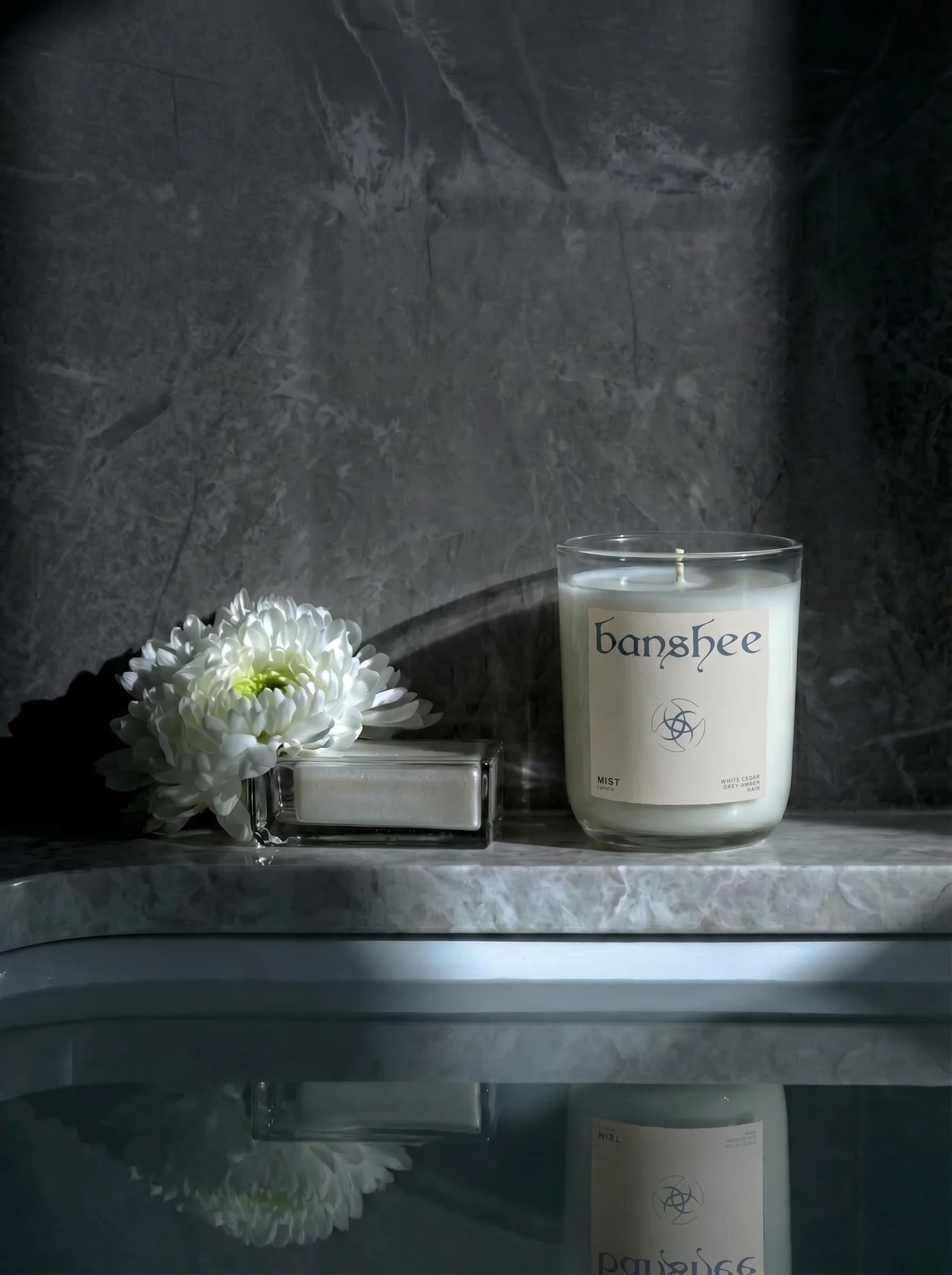
There is a kind of fragrance that does its work by being barely there.
Not weak. Not subtle as a euphemism for thin. Quiet in the same way certain pieces of music are quiet — by holding back, by leaving space, by trusting the listener to come closer rather than projecting outward to meet them.
Three of the four Banshee scents work this way. This is a piece about what they are doing.
What Veil holds
Veil is a scent of softness against the skin.
The dominant material is something close to clean wool — the smell of a blanket that has been folded in a cedar drawer for a season. Underneath that, a quiet powdery note that reads as iris or as the chalk of old plaster, depending on the room. A trace of something cooler beneath both, a green that is not herbal so much as the green of moss in shaded stone.
Veil does not project. It rests on the air around it. Burn it in a small room and you will not smell it from the next room. This is by design. Veil is for the bedside, the bath, the chair you read in. It is for the rooms small enough to contain it.
The quiet of Veil is the quiet of a room that has been made comfortable for a single person.
What Lament holds
Lament is heavier than Veil but no louder.
The base is something like wet wood — the smell of timber that has been left out in weather, the dark interior of a beam that has darkened over years. Above that, a smoky note that does not read as fire so much as as the residue of one. Something resinous, low and slightly bitter, like the underside of a fern. A trace of salt, very faint, almost imagined.
Lament fills a room without dominating it. The scent settles into the corners rather than pushing out from the centre. Burn it in a larger space and you will notice it from across the room without it announcing itself.
The quiet of Lament is the quiet of a room that has gone through something and is still there.
What Peat holds
Peat is the warmest of the three, and the most material.
The dominant note is exactly what the name suggests — the smell of cut turf, dried, beginning to smoulder. Behind it, a deeper earth note, mineral and almost mushroom-like. A small amount of smoked tea, which sounds like a stretch until you smell it, at which point it makes complete sense. A trace of something animal at the very bottom, leather perhaps, or skin, kept low enough that it registers as warmth rather than as identifiable material.
Peat is the loudest of the three, but loud here is relative. It still does not project across a room. It fills the air around the candle in a soft dense layer that you walk into rather than receive from a distance.
The quiet of Peat is the quiet of a fire that has been burning long enough to become part of the room.
What these three share
None of these scents are bright. None of them open with a sharp top note. None of them are designed to scent a large room.
They are all built around materials with weight — wool, wood, peat, salt, ash, plaster, iron-adjacent minerals. These are the materials of old buildings, old weather, old rooms. They register in the body as familiar even on first encounter, because the body has been recognizing them for a long time even when the mind has not.
This is the quiet power. The scents do not have to argue for themselves. The body recognizes them and responds before the mind has assessed.
What the fourth is
Mist sits slightly outside this family. It is cooler, more open, less material. It is the doorway scent — meant to meet you in motion rather than hold you in stillness. Mist is the one we made for arrival. The other three are for what arrival ends in.
If you have lit one of the three and want to understand why it does what it does, the answer is in the materials. Old materials. Materials that have been part of human rooms for a long time.
The fragrance is not new. We are only arranging what was already familiar.
We are only arranging what was already familiar.